


AI Models for Protein Structure Prediction

Boltz-2
Boltz-2 is an AI model for predicting biomolecular structures and interactions. Developed by researchers at MIT and collaborators, Boltz-2 combines advanced deep-learning methods to predict biomolecular structures and protein–ligand binding affinity. By bringing structure prediction and binding-affinity prediction together, Boltz-2 is suited to molecular-design workflows where both structural modeling and protein–ligand interaction are important.
- Structure prediction: Predicts three-dimensional structures for biomolecular complexes.
- Binding-affinity prediction: Adds protein–ligand affinity prediction alongside structural prediction.
- Protein–ligand modeling: Supports systems containing proteins and small molecules.
- Heterogeneous complexes: Supports proteins, DNA, RNA, small molecules, and other molecular components.
Created by
Saro Passaro, Gabriele Corso, Jeremy Wohlwend, Mateo Reveiz, Stephan Thaler, Vignesh Ram Somnath, Noah Getz, Tally Portnoi, Julien Roy, Hannes Stark, David Kwabi-Addo, Dominique Beaini, Tommi Jaakkola, and Regina Barzilay.
Research & Benchmarking
The Boltz-2 reference publication and an independent evaluation are presented below, followed by DNASTAR’s local-versus-cloud benchmark.
Boltz-2 reference publication
Independent AlphaFold 3 comparison
RESEARCH ARTICLE • PREPRINT
Boltz-2: Towards Accurate and Efficient Binding Affinity Prediction
bioRxiv • 2025 • doi: 10.1101/2025.06.14.659707
Boltz-2 is a structural biology foundation model for biomolecular complex structure and binding-affinity prediction, with controllable structure prediction and strong affinity-prediction performance.
INDEPENDENT EVALUATION
AI-Based Prediction of PROTAC- and Molecular Glue-Mediated Ternary Complexes: A Comparative Evaluation of AlphaFold 3 and Boltz-2
Archiv der Pharmazie • 2026
Independent benchmarking across 40 experimentally resolved ternary complexes found slightly lower overall complex RMSD and substantially reduced inference times for Boltz-2.



DNASTAR Benchmarks
The limiting hardware resource for Boltz-2 predictions is GPU memory (VRAM).
Cloud vs. Local Performance
DNASTAR benchmark comparing Boltz-2 prediction times on a local computer with an NVIDIA RTX 6000 (96 GB VRAM) and Amazon cloud with an NVIDIA Tensor Core GPU (48 GB VRAM).
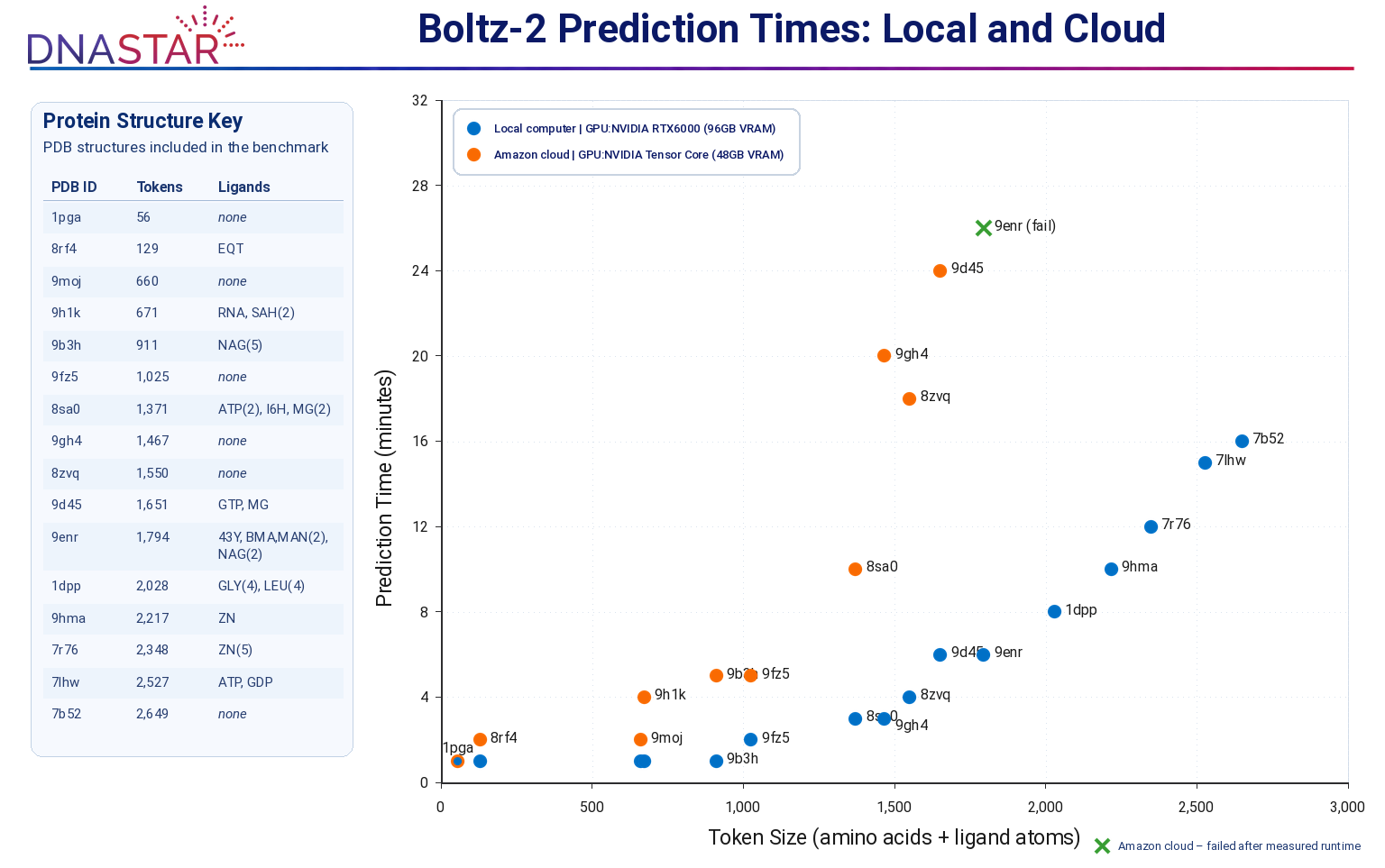
The graph reports measured prediction times for the benchmark structures. Green X markers indicate Amazon-cloud predictions that failed after the measured runtime.


