


AI Models for Protein Structure Prediction

AlphaFold2 with ColabFold
ColabFold is an open-source protein-structure prediction framework built around AlphaFold2. It improves the practical speed and accessibility of AlphaFold2 by replacing its computationally intensive homology-search workflow with the much faster MMseqs2 sequence-search system, while also optimizing model inference and batch processing. ColabFold uses MMseqs2 to rapidly identify homologous sequences and templates and construct multiple-sequence alignments (MSAs), which are then provided to AlphaFold2-based models to predict three-dimensional protein structures. The framework also supports protein-complex prediction and provides both Google Colab notebooks and local tools, enabling high-quality structure prediction to be performed more quickly and at greater scale.
- MMseqs2-accelerated searches: Rapidly generates MSAs using the fast MMseqs2 sequence-search system.
- AlphaFold2-based prediction: Uses AlphaFold2 models to predict high-quality three-dimensional protein structures.
- Protein-complex prediction: Supports homo- and heteromeric protein-complex prediction.
- Fast batch prediction: Optimizes inference and uses early stopping to accelerate large-scale prediction.
- Flexible workflows: Supports Google Colab and local execution, with controls for MSAs, templates, recycling, and model sampling.
Created by
Milot Mirdita, Konstantin Schütze, Yoshitaka Moriwaki, Lim Heo, Sergey Ovchinnikov, and Martin Steinegger.
Research & Benchmarking
Research publications and benchmarking resources for ColabFold.
ColabFold reference publication
GPU-accelerated homology search with MMseqs2
RESEARCH ARTICLE • 2022
ColabFold: making protein folding accessible to all
Nature Methods • 2022 • doi: 10.1038/s41592-022-01488-1
ColabFold combines fast MMseqs2 homology searches with AlphaFold2 or RoseTTAFold to accelerate protein structure and complex prediction and make high-quality structure prediction more accessible.
RESEARCH ARTICLE • 2025
GPU-accelerated homology search with MMseqs2
Nature Methods • 2025 • doi: 10.1038/s41592-025-02819-8
GPU-accelerated MMseqs2 substantially speeds protein homology searches and accelerates ColabFold protein structure prediction compared with the standard AlphaFold2 workflow.
DNASTAR Benchmarks
The limiting hardware factor for ColabFold predictions is GPU memory (VRAM). Also note that predictions of multi-subunit protein structures are significantly slower than single subunit proteins.
Cloud vs. Local Performance
Measured ColabFold prediction times for the benchmark structures on a local computer and Amazon cloud GPU.
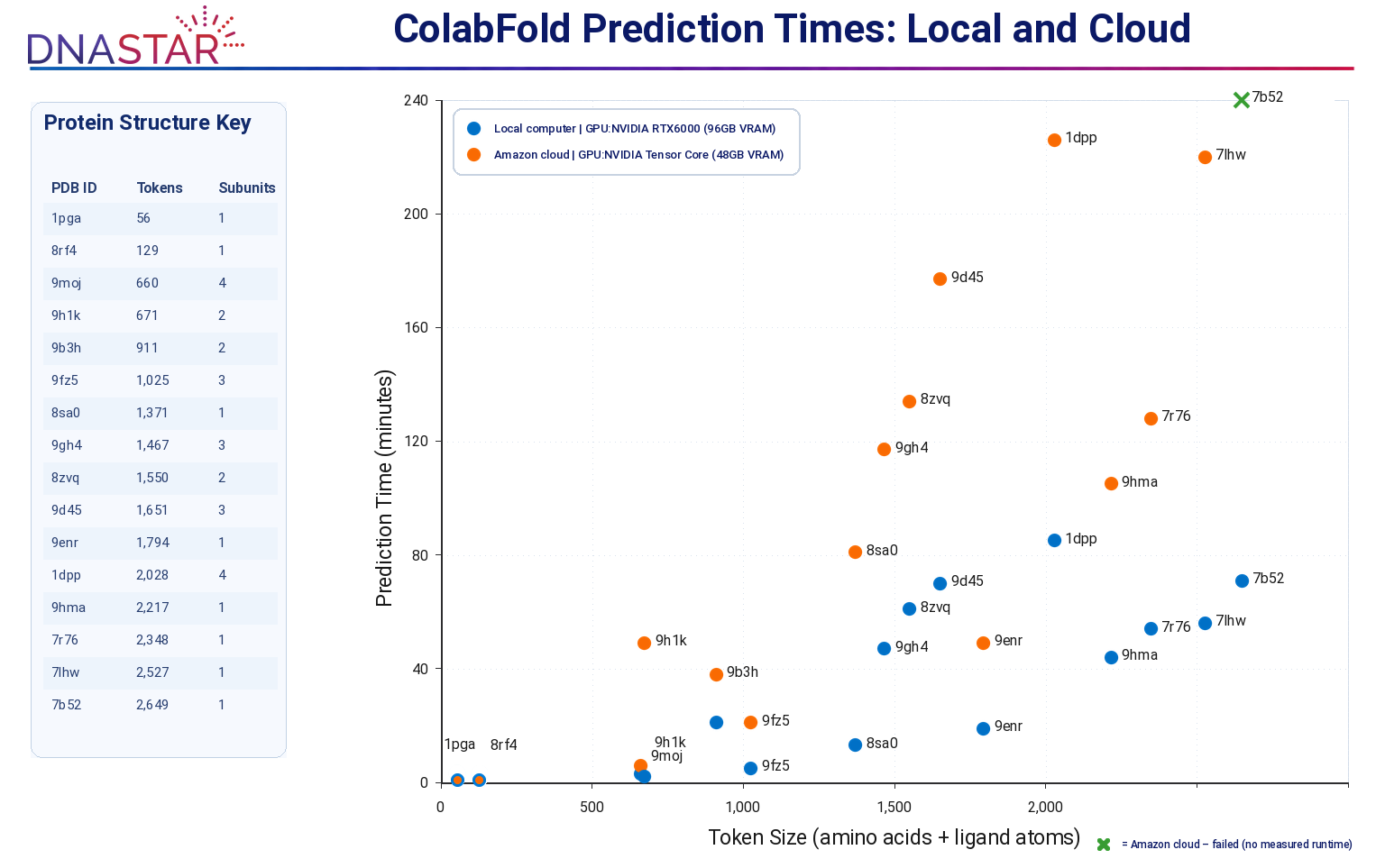
The graph reports measured prediction times for the benchmark structures. Green X markers indicate Amazon-cloud predictions that failed after the measured runtime.


