

• Software
    • DNASTAR Lasergene
      • Lasergene Molecular Biology
      • Lasergene Genomics
      • Lasergene Protein
  • Workflows
    • Molecular Biology Workflows
      • Automated Virtual Cloning
      • Clone Sequence Verification
      • ELN Integration
      • Gel Electrophoresis Simulation
      • Gene Homology Alignment
      • Multiple Sequence Alignment
      • Pairwise Sequence Alignment
      • PCR Site-Directed Mutagenesis
      • PCR Primer Design
      • Phylogenetic Analysis
      • Plasmid Maps
      • Sanger Sequence Assembly
      • Sequence Editing and Annotation
  • Protein Analysis
    • AI-Powered Protein Structure Prediction
    • Antibody Modeling
    • Antibody Phage Display
    • Epitope Prediction
    • Protein Docking
    • Protein Sequence Analysis
    • Protein Stability Prediction
    • Protein Structural Alignment
    • Protein Structure Analysis
  • Genomics
    • Clinical Research
    • De Novo Genome Assembly
    • Mauve Genome Alignment
    • Metagenomic Assembly
    • Variant Analysis
    • Viral Genome Analysis
    • Whole Genome/Whole Exome
  • Transcriptomics
    • ChIP-Seq Data Analysis
    • De Novo Transcriptome Assembly
    • RNA-Seq Alignment
  • Services
    • Protein Services
    • Genomic Services
  • Pricing
  • Resources
    • KNOWLEDGE CENTER
      • User Guides and Tutorials
      • Product Literature
      • Product Releases
      • Product Notifications
      • Supported File Formats
      • Technical Requirements
      • Citations
    • WEBINARS & EVENTS
    • BLOG
    • LICENSING OPTIONS
  • About
    • Careers
    • Distributors
    • Legal Information
    • Privacy Policy
  • Contact
  • Free Trial

Lasergene 19.0.2 Release Notes

REQUEST FREE TRIAL
MY ACCOUNT
DNASTARDNASTAR
  • Software
    • DNASTAR Lasergene
      Full Suite
    • Lasergene Molecular Biology
    • Lasergene Genomics
    • Lasergene Protein
  • Workflows
    • Molecular Biology
      • Automated Virtual Cloning
      • Clone Sequence Verification
      • ELN Integration
      • Gel Electrophoresis Simulation
      • Gene Homology Alignment
      • Multiple Sequence Alignment
      • Pairwise Sequence Alignment
      • PCR Site-Directed Mutagenesis
      • PCR Primer Design
      • Phylogenetic Analysis
      • Plasmid Maps
      • Sanger Sequence Assembly
      • Sequence Editing and Annotation
    • Protein Analysis
      • AI-Powered Protein Structure Prediction
      • Antibody Modeling
      • Antibody Phage Display
      • Epitope Prediction
      • Protein Docking
      • Protein Sequence Analysis
      • Protein Stability Prediction
      • Protein Structural Alignment
      • Protein Structure Analysis
    • Genomics
      • Clinical Research
      • De Novo Genome Assembly
      • Mauve Genome Alignment
      • Metagenomic Assembly
      • Variant Analysis
      • Viral Genome Analysis
      • Whole Exome/Genome Sequencing
    • Transcriptomics
      • ChIP-Seq Data Analysis
      • De Novo Transcriptome Assembly
      • RNA-Seq Alignment and Analysis
  • Services
    • Protein Services
    • Genomic Services
  • Pricing
  • Resources
    • KNOWLEDGE CENTER
      • User Guides and Tutorials
      • Product Literature
      • Product Releases
      • Product Notifications
      • Supported File Formats
      • Technical Requirements
      • Citations
    • WEBINARS
    • NEWS AND EVENTS
    • BLOG
    • LICENSING OPTIONS
  • About
    • Careers
    • Distributors
    • Legal Information
    • Privacy Policy
  • Contact
  • Search
  • Free Trial

AI Models for Protein Structure Prediction


Protein Structure Prediction →

OpenDDE

OpenDDE is an open-source, all-atom biomolecular foundation model developed by Aureka AI Research. Rather than predicting a protein structure in isolation, OpenDDE uses co-folding to model complete biomolecular assemblies, including proteins, nucleic acids, small-molecule ligands, ions, and covalent interactions, within a single structural framework. It is designed for antibody-antigen structure prediction, protein-ligand modeling, molecular design, and structure-conditioned optimization. Choose OpenDDE when you want to understand or design a biomolecular complex, particularly in a drug-discovery context, rather than simply predict the structure of a single protein.

  • All-atom co-folding: Models complete biomolecular assemblies within a unified structural framework.
  • Multiple molecular components: Supports proteins, nucleic acids, small-molecule ligands, ions, and covalent interactions.
  • Complex-focused prediction: Particularly suited to studying interactions such as antibody-antigen and protein-ligand complexes.
  • Structure-guided molecular design: Supports applications in molecular design and structure-conditioned optimization.
  • Open-source foundation: Provides an open framework for researchers to run, evaluate, and build upon the technology.

Created by

Aureka AI Research

Research & Benchmarking

OpenDDE reference publication

FoldBench benchmark

RESEARCH ARTICLE • PREPRINT

Folding, Reasoning, and Scaling with Open-source Drug Discovery Engine

Aureka AI OpenDDE project

arXiv • 2026 • doi: 10.48550/arXiv.2607.03787

Introduces OpenDDE, an open-source, all-atom biomolecular foundation model that uses co-folding as the entry point to an AI-driven drug discovery engine. The work presents OpenDDE as a shared structural reasoning framework for biomolecular complex prediction and future applications in molecular design and optimization.

Download PDF
View full text

RESEARCH ARTICLE • OPEN ACCESS

Benchmarking all-atom biomolecular structure prediction with FoldBench

Sheng Xu, Qiantai Feng, Lifeng Qiao, Hao Wu, Tao Shen, Yu Cheng, Shuangjia Zheng & Siqi Sun

Nature Communications • 2026 • doi: 10.1038/s41467-025-67127-3

Introduces FoldBench, a low-homology benchmark of 1,522 biological assemblies spanning nine prediction tasks. The benchmark includes 172 antibody-antigen interfaces and identifies antibody-antigen prediction as a particularly challenging task for current all-atom structure prediction methods.

Download PDF
View full text

DNASTAR Benchmarks

The limiting hardware factor for OpenDDE predictions is GPU memory (VRAM).

Cloud vs. Local Performance

DNASTAR benchmark comparing OpenDDE prediction times on a local computer with an NVIDIA RTX 6000 (96 GB VRAM) and Amazon cloud with an NVIDIA Tensor Core GPU (48 GB VRAM).
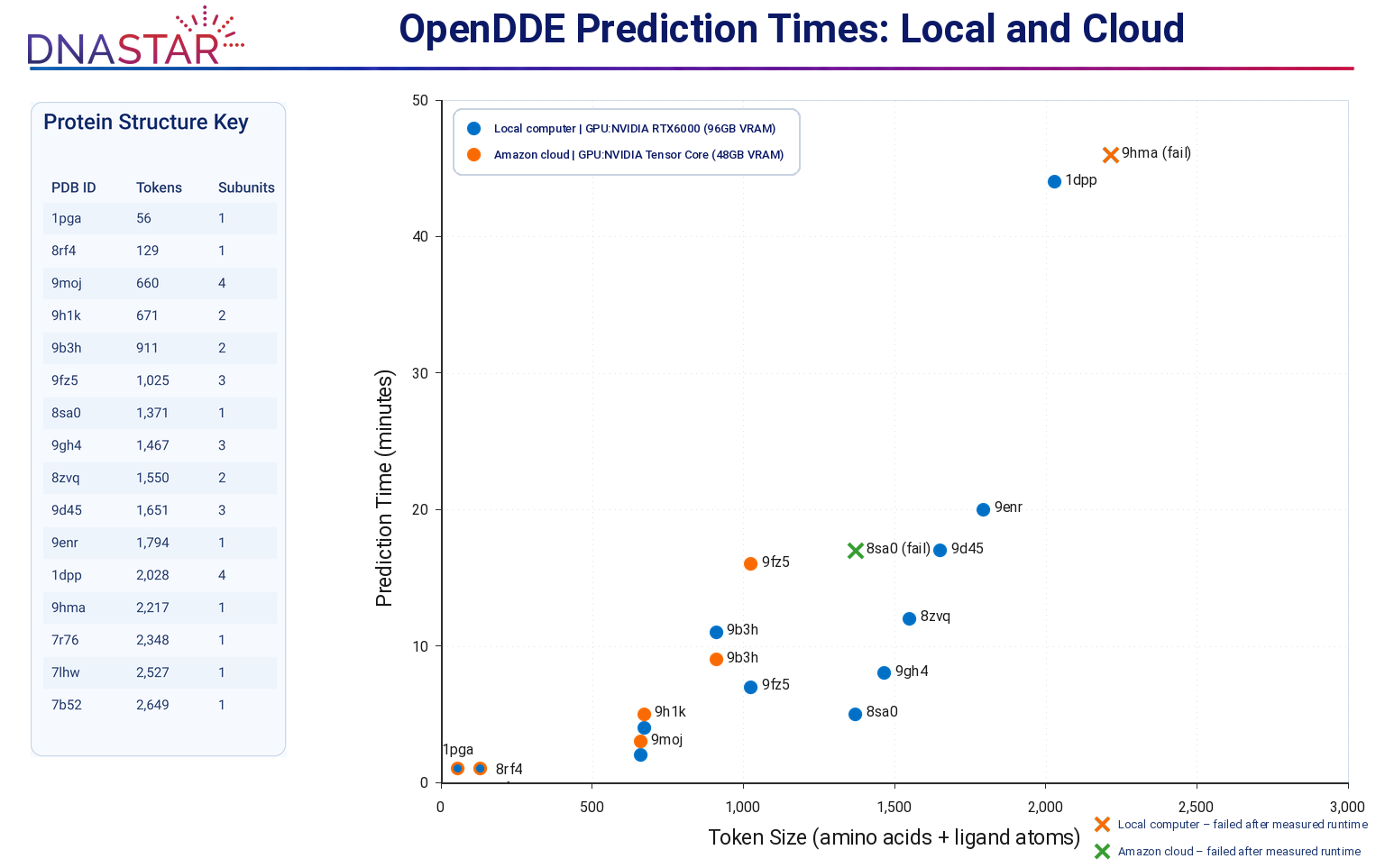
The benchmark graph reports measured prediction times for the listed protein structures. Orange X markers indicate local-computer predictions that failed after measured runtime; green X markers indicate Amazon-cloud predictions that failed after measured runtime.

Ready to learn more? PRICING START FREE TRIAL computer

Would you like to receive technical tips and special offers straight to your inbox?

DNASTAR
Pricing Workflows Training Software Resources Contact Us

Would you like to receive technical tips and special offers straight to your inbox?

2026 - DNASTAR Privacy Policy
This website uses cookies to improve user experience and understand our web usage. By continuing to use our website, you consent to our use of cookies. Accept
Privacy & Cookies Policy

Privacy Overview

This website uses cookies to improve your experience while you navigate through the website. Out of these, the cookies that are categorized as necessary are stored on your browser as they are essential for the working of basic functionalities of the website. We also use third-party cookies that help us analyze and understand how you use this website. These cookies will be stored in your browser only with your consent. You also have the option to opt-out of these cookies. But opting out of some of these cookies may affect your browsing experience.
Necessary
Always Enabled
Necessary cookies are absolutely essential for the website to function properly. This category only includes cookies that ensures basic functionalities and security features of the website. These cookies do not store any personal information.
Non-necessary
Any cookies that may not be particularly necessary for the website to function and is used specifically to collect user personal data via analytics, ads, other embedded contents are termed as non-necessary cookies. It is mandatory to procure user consent prior to running these cookies on your website.
SAVE & ACCEPT