

• Software
    • DNASTAR Lasergene
      • Lasergene Molecular Biology
      • Lasergene Genomics
      • Lasergene Protein
  • Workflows
    • Molecular Biology Workflows
      • Automated Virtual Cloning
      • Clone Sequence Verification
      • ELN Integration
      • Gel Electrophoresis Simulation
      • Gene Homology Alignment
      • Multiple Sequence Alignment
      • Pairwise Sequence Alignment
      • PCR Site-Directed Mutagenesis
      • PCR Primer Design
      • Phylogenetic Analysis
      • Plasmid Maps
      • Sanger Sequence Assembly
      • Sequence Editing and Annotation
  • Protein Analysis
    • Antibody Modeling
    • Antibody Phage Display
    • Epitope Prediction
    • Protein Docking
    • Protein Sequence Analysis
    • Protein Stability Prediction
    • Protein Structural Alignment
    • Protein Structure Analysis
    • Protein Structure Prediction
  • Genomics
    • Clinical Research
    • De Novo Genome Assembly
    • Mauve Genome Alignment
    • Metagenomic Assembly
    • Variant Analysis
    • Viral Genome Analysis
    • Whole Genome/Whole Exome
  • Transcriptomics
    • ChIP-Seq Data Analysis
    • De Novo Transcriptome Assembly
    • RNA-Seq Alignment
  • Services
    • Protein Services
    • Genomic Services
  • Pricing
  • Resources
    • KNOWLEDGE CENTER
      • User Guides and Tutorials
      • Product Literature
      • Product Releases
      • Product Notifications
      • Supported File Formats
      • Technical Requirements
      • Citations
    • WEBINARS & EVENTS
    • BLOG
    • LICENSING OPTIONS
  • About
    • Careers
    • Distributors
    • Legal Information
    • Privacy Policy
  • Contact
  • Free Trial

Lasergene 19.0 Release Notes

REQUEST FREE TRIAL
MY ACCOUNT
DNASTARDNASTAR
  • Software
    • DNASTAR Lasergene
      Full Suite
    • Lasergene Molecular Biology
    • Lasergene Genomics
    • Lasergene Protein
  • Workflows
    • Molecular Biology
      • Automated Virtual Cloning
      • Clone Sequence Verification
      • ELN Integration
      • Gel Electrophoresis Simulation
      • Gene Homology Alignment
      • Multiple Sequence Alignment
      • Pairwise Sequence Alignment
      • PCR Site-Directed Mutagenesis
      • PCR Primer Design
      • Phylogenetic Analysis
      • Plasmid Maps
      • Sanger Sequence Assembly
      • Sequence Editing and Annotation
    • Protein Analysis
      • Antibody Modeling
      • Antibody Phage Display
      • Epitope Prediction
      • Protein Docking
      • Protein Sequence Analysis
      • Protein Stability Prediction
      • Protein Structural Alignment
      • Protein Structure Analysis
      • Protein Structure Prediction
    • Genomics
      • Clinical Research
      • De Novo Genome Assembly
      • Mauve Genome Alignment
      • Metagenomic Assembly
      • Variant Analysis
      • Viral Genome Analysis
      • Whole Exome/Genome Sequencing
    • Transcriptomics
      • ChIP-Seq Data Analysis
      • De Novo Transcriptome Assembly
      • RNA-Seq Alignment and Analysis
  • Services
    • Protein Services
    • Genomic Services
  • Pricing
  • Resources
    • KNOWLEDGE CENTER
      • User Guides and Tutorials
      • Product Literature
      • Product Releases
      • Product Notifications
      • Supported File Formats
      • Technical Requirements
      • Citations
    • WEBINARS
    • NEWS AND EVENTS
    • BLOG
    • LICENSING OPTIONS
  • About
    • Careers
    • Distributors
    • Legal Information
    • Privacy Policy
  • Contact
  • Search
  • Free Trial

Q&A with Principal Scientist Steve Darnell

Home » Q&A with Principal Scientist Steve Darnell

Q&A with Principal Scientist Steve Darnell

October 1, 2020 Resources

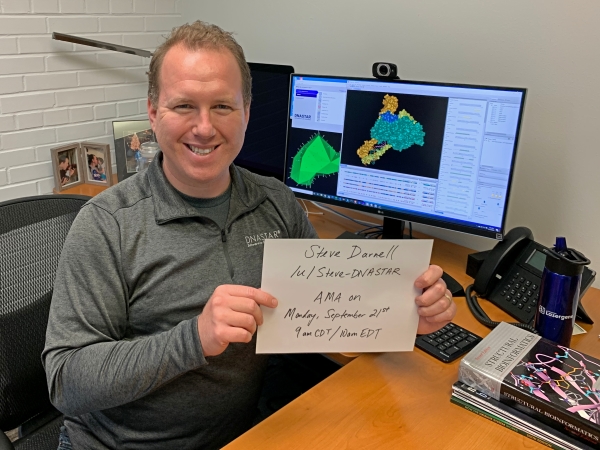
Last week DNASTAR’s Principal Scientist Steve Darnell participated in our very first Ask Me Anything, or AMA, on Reddit. An AMA is a crowdsourced interview where Reddit users can leave questions for the interviewee to answer and vote on other questions they would like to see answered. Steve answered over 50 questions, and topics ranged from career and academic advice to specific questions about the types of proteins he works with and the scripting languages he uses. You can find some of the most requested questions below or go the reddit site to find the full list of answered questions.


Question: When you first started your undergrad did you set out with the intention of studying structural bioinformation or did you kind of stumble into your career like many of us did?


Answer: I stumbled into this area like most others. I started thinking I would be a chemist. I added the biochemistry major late in college which took me into an extra year, so I tried a few CS courses. In grad school, but I didn’t get placed in a lab after rotations (we had a record class size). I was later placed with a first-year biochemistry professor with a cross appointment in math and a focus in structural biology… and the rest is history.


Question: Vmd, pymol, or Chimera? And which do you think is more powerful under the hood? Are there any new software hitting the ‘market’ that handle trajectories well? And how big of a system have you run through at all atom scale?


Answer: VMD was purpose built to view molecular dynamics trajectories. All three of your options have scripting languages which make them all pretty powerful. If you’re a python scripter like me, then PyMOL is the way to go. The plug-in system is nice for community contributions, but different plug-ins are easier to setup. Chimera has some wonderful visualization capabilities, including ambient occlusion in ChimeraX.

I am the leader of the development team behind Protean 3D, which is a 3D molecular visualization program combined with integrated bioinformatics and sequence analysis capabilities. It fills a slightly different need, but we’re continuing to move it forward.

I have some historical experience using MD, mostly running basic equilibrium simulations to sample structural diversity for other needs. We use different “simulation” techniques for predicting protein structures or docking proteins together, but the visualization tends to focus on the endpoints. Sorry I don’t have anymore insight into tools that have strong trajectory support. I’d be interested in hearing what you find out!


Question: I’m currently an undergrad trying to decide now whether I want to follow a path into biostat[istics] or working in a wet lab. What concerns me, though, is that I really don’t have a strong background in Python or R coding. Did you start coding before entering post secondary or did you develop the skills you use while in college?

Also, would you recommend any useful “hubs” of information that those in the field generally go for updates in the field other than sites like ScienceDaily etc or to discuss the state of bioinformatics in a non conference setting?


Answer: It’s great that you’re thinking ahead so early. So don’t worry about not having a strong coding background right now. I didn’t take a CS class until my last years of college (they taught me Java at the time). I dabbled for awhile until I ended up in grad school in a biology/mathematics lab. That’s where I really got better with C/Python/bash/etc. It’s much easier to get good fast when you’re immersed in the work every day.

As for updates, I have some subreddit subscriptions that I rely on or my Google News feed has become pretty good at knowing what I like scientifically. Mostly, I still rely on speaking with my friends and colleagues (even in a post-COVID world) for most of it. As for structural biology, you can’t beat the annual 3DSig satellite conference at ISCB.


Question: What’s the coolest DNA sequence you’ve designed and for what purpose? How does CRISPR fit into your position? Are there any ethics considerations?


Answer: My current position really focuses on enabling other researchers to design protein sequences through software. Back in the day, I worked on a proof-of-concept to improve the binding of a protein called SMAD4 to a protein called Ski, both which are part the TGF-beta pathway (involved in apoptosis). That was accomplished by making site-directed mutation to 1-3 positions.

Right now I’m devoting a lot of time to designing antibodies with the aid of computer modeling and experimental screening. CRISPR doesn’t fit into those plans, so I don’t have to worry about the ethics of gene editing for now.


Question: Do you use machine learning for this kind of work? If so, what specific algorithm types fit best?


Answer: Yes we do and the absolute best algorithms are… it depends. Random forests are still used a lot for classification and regression because of their general purpose and relatively robust nature. We use them in part for modeling antibody loops onto framework structures. Xgboost is supposed to work wonders on tabular data, and I have some work in mind for that.

Deep learning (Resnet variants) has been applied successfully to the area of protein structure prediction and there are growing examples of NLP being applied to creating a “grammar for protein sequences.” My current workstation was designed to let me start some proof of concepts in this area. I’m trying to carve out some time to join in the fun!


Share
0

You also might be interested in

Q&A: Assembling and Analyzing NGS & Long Read Sequences

Q&A: Assembling and Analyzing NGS & Long Read Sequences

May 15, 2023

This post answers some recent DNASTAR customer questions related to NGS and long read sequence assembly. Whether you're curious about normalization methods for RNA-Seq or wonder how Lasergene Genomics software recognizes poor-quality sequencing data, you can find the answers below.

Protean 3D cannot save NovaFold AI prediction results as .structure documents

Protean 3D cannot save NovaFold AI prediction results as .structure documents

Apr 27, 2023

Date: 4/27/2023 Version Affected: Lasergene 17.32 to 17.4.2 Version Fixed: Lasergene 17.4.3 and later

Alignment in MegAlign Pro with protein analysis tracks

Lasergene 17.5 Release Notes

Jun 27, 2023

Lasergene 17.5 includes significant enhancements for NGS and Sanger workflows, multiple sequence alignments, and security updates.

2 Comments

Leave your reply.
  • Michael Zuber
    · Reply

    May 20, 2024 at 2:02 PM

    Hey Steve,

    I saw your presentation on AlphaFold Multimer. Although I submitted this same question elsewhere, given your expertise, I thought it best to contact you directly.

    I have been working with a relatively small vertebrate gene that I hypothesize evolved from a much larger invertebrate gene. It appears that a larger (invertebrate) gene underwent a fission event to generate my gene and another gene during evolution. My experiments suggest the corresponding vertebrate proteins still function together in a complex. I wonder if Novafold AI and AlphaFold-Multimer could be used to test my hypothesis. What do you think of this idea? To test my hypothesis, I would use Novafold AI to fold the single two-domain invertebrate protein and the two independent vertebrate proteins. Then use Alphafold-Multimer to identify how the two independent vertebrate proteins likely interact. If my hypothesis is true, the interaction domains of the two independent vertebrate proteins should match how the two-domain invertebrate protein folds. I am very excited about the possibility of this working and would love to give it a try. I have identified dozens of invertebrate and hundreds of vertebrate versions of these proteins so perhaps I could take full advantage of coevolution as well? Let me know what you think. Best, Mike

    • Sharon Yildiz
      · Reply

      May 20, 2024 at 4:57 PM

      Thanks for writing, Michael. I’ve forwarded your inquiry to Steve over email.

Leave a Reply

Your email is safe with us.
Cancel Reply

Search Blog Posts

  • CATEGORIES

    • Genomics
    • Protein Analysis & Modeling
    • Sequence Analysis
    • Transcriptomics

Recent Posts

  • How to Create the Best Phylogenetic Tree for Your Data Using MegAlign Pro April 3, 2026
  • Improving Genome Assemblies with PacBio HiFi Sequencing April 14, 2025
  • Phased Variant (Haplotype) Analysis for Whole Genome Sequencing November 14, 2024
  • What Can We Learn from Gene Homology Analysis? May 23, 2024
  • How to Assemble Genomes like a Bioinformatics Pro October 17, 2023
[show_tag]

Archives

Find us on

Most Commented Posts

  • Comprehensive Variant Analysis Webinar By Anne Stover on November 3, 2022 6
  • Compatibility issues with macOS Big Sur By Sharon Page on November 10, 2020 3
  • Accurate Protein Structure Prediction Webinar By Anne Stover on September 27, 2022 3

Would you like to receive technical tips and special offers straight to your inbox?

DNASTAR
Pricing Workflows Training Software Resources Contact Us

Would you like to receive technical tips and special offers straight to your inbox?

2026 - DNASTAR Privacy Policy
Prev Next
This website uses cookies to improve user experience and understand our web usage. By continuing to use our website, you consent to our use of cookies. Accept
Privacy & Cookies Policy

Privacy Overview

This website uses cookies to improve your experience while you navigate through the website. Out of these, the cookies that are categorized as necessary are stored on your browser as they are essential for the working of basic functionalities of the website. We also use third-party cookies that help us analyze and understand how you use this website. These cookies will be stored in your browser only with your consent. You also have the option to opt-out of these cookies. But opting out of some of these cookies may affect your browsing experience.
Necessary
Always Enabled
Necessary cookies are absolutely essential for the website to function properly. This category only includes cookies that ensures basic functionalities and security features of the website. These cookies do not store any personal information.
Non-necessary
Any cookies that may not be particularly necessary for the website to function and is used specifically to collect user personal data via analytics, ads, other embedded contents are termed as non-necessary cookies. It is mandatory to procure user consent prior to running these cookies on your website.
SAVE & ACCEPT