

• Software
    • DNASTAR Lasergene
      • Lasergene Molecular Biology
      • Lasergene Genomics
      • Lasergene Protein
  • Workflows
    • Molecular Biology Workflows
      • Automated Virtual Cloning
      • Clone Sequence Verification
      • ELN Integration
      • Gel Electrophoresis Simulation
      • Gene Homology Alignment
      • Multiple Sequence Alignment
      • Pairwise Sequence Alignment
      • PCR Site-Directed Mutagenesis
      • PCR Primer Design
      • Phylogenetic Analysis
      • Plasmid Maps
      • Sanger Sequence Assembly
      • Sequence Editing and Annotation
  • Protein Analysis
    • Antibody Modeling
    • Antibody Phage Display
    • Epitope Prediction
    • Protein Docking
    • Protein Sequence Analysis
    • Protein Stability Prediction
    • Protein Structural Alignment
    • Protein Structure Analysis
    • Protein Structure Prediction
  • Genomics
    • Clinical Research
    • De Novo Genome Assembly
    • Mauve Genome Alignment
    • Metagenomic Assembly
    • Variant Analysis
    • Viral Genome Analysis
    • Whole Genome/Whole Exome
  • Transcriptomics
    • ChIP-Seq Data Analysis
    • De Novo Transcriptome Assembly
    • RNA-Seq Alignment
  • Services
    • Protein Services
    • Genomic Services
  • Pricing
  • Resources
    • KNOWLEDGE CENTER
      • User Guides and Tutorials
      • Product Literature
      • Product Releases
      • Product Notifications
      • Supported File Formats
      • Technical Requirements
      • Citations
    • WEBINARS & EVENTS
    • BLOG
    • LICENSING OPTIONS
  • About
    • Careers
    • Distributors
    • Legal Information
    • Privacy Policy
  • Contact
  • Free Trial

Lasergene 19.0 Release Notes

REQUEST FREE TRIAL
MY ACCOUNT
DNASTARDNASTAR
  • Software
    • DNASTAR Lasergene
      Full Suite
    • Lasergene Molecular Biology
    • Lasergene Genomics
    • Lasergene Protein
  • Workflows
    • Molecular Biology
      • Automated Virtual Cloning
      • Clone Sequence Verification
      • ELN Integration
      • Gel Electrophoresis Simulation
      • Gene Homology Alignment
      • Multiple Sequence Alignment
      • Pairwise Sequence Alignment
      • PCR Site-Directed Mutagenesis
      • PCR Primer Design
      • Phylogenetic Analysis
      • Plasmid Maps
      • Sanger Sequence Assembly
      • Sequence Editing and Annotation
    • Protein Analysis
      • Antibody Modeling
      • Antibody Phage Display
      • Epitope Prediction
      • Protein Docking
      • Protein Sequence Analysis
      • Protein Stability Prediction
      • Protein Structural Alignment
      • Protein Structure Analysis
      • Protein Structure Prediction
    • Genomics
      • Clinical Research
      • De Novo Genome Assembly
      • Mauve Genome Alignment
      • Metagenomic Assembly
      • Variant Analysis
      • Viral Genome Analysis
      • Whole Exome/Genome Sequencing
    • Transcriptomics
      • ChIP-Seq Data Analysis
      • De Novo Transcriptome Assembly
      • RNA-Seq Alignment and Analysis
  • Services
    • Protein Services
    • Genomic Services
  • Pricing
  • Resources
    • KNOWLEDGE CENTER
      • User Guides and Tutorials
      • Product Literature
      • Product Releases
      • Product Notifications
      • Supported File Formats
      • Technical Requirements
      • Citations
    • WEBINARS
    • NEWS AND EVENTS
    • BLOG
    • LICENSING OPTIONS
  • About
    • Careers
    • Distributors
    • Legal Information
    • Privacy Policy
  • Contact
  • Search
  • Free Trial

TIPS FOR SUCCESSFUL DE NOVO TRANSCRIPTOME SEQUENCE ASSEMBLY
USING RNA-SEQ DATA

DOWNLOAD THIS GUIDE

Home > Product Literature > Lasergene Genomics vs CLC Genomics Workbench | DNASTAR

  • Introduction
  • Chapter 1

    The De Novo Transcriptome Analysis Workflow

  • Chapter 2

    Using Lasergene Genomics to Streamline the Workflow

  • Chapter 3

    Third-Party Comparison: Lasergene Genomics vs. CLC Genomic Workbench

  • Conclusion

Chapter 3: Third-Party Comparison: Lasergene Genomics vs. CLC Genomics Workbench

Third-Party Comparison: Lasergene Genomics vs. CLC Genomics Workbench

We think the de novo transcriptome workflow in Lasergene Genomics is a leader in its class, and this 2018 study agreed that SeqMan NGen performed this workflow better than CLC Genomics Workbench in a variety of areas.

REFERENCE: Jonathan Chacon and Math P. Cuajungco. “Comparative De novo Transcriptome Assembly of Notophthalmus viridescens RNA-seq Data using Two Commercial Software Programs.” Calif J Health Promot. 2018 Jun; 16(1): 46–53.

Read the Paper

Below, we expand on some of the findings identified in the paper.

To download this entire ebook as a PDF, click here.

DOWNLOAD THIS GUIDE

Flexible assembly setup

The study authors report that SeqMan NGen “…allows users to specify rRNA or other input contaminant sequences prior to assembly. This option is not currently available in the CLC GW de novo transcriptome workflow.”

In addition to letting you specify rRNA and other contaminant sequences, SeqMan NGen’s wizard also lets you remove specific vector or adapter sequences (Figure 2). Alternatively, you can elect to perform fully automated adapter removal by checking the “Remove universal adapter” option.

Fewer and longer contigs

With other applications, de novo assembly of RNA-Seq data can potentially result in thousands of unlabeled contigs representing the expressed transcripts. Performing meaningful downstream analysis on this many unannotated contigs is nearly impossible.

Using its proprietary assembly algorithm, however, SeqMan NGen creates fewer and longer contigs than CLC Genomics Workbench. The study authors noted that “… the Lasergene SMN Trace Evidence consensus-calling algorithm generated longer contigs on average…Meanwhile, CLC GW had assembled over nine times the amount of contigs…”

How does SeqMan NGen do it? SeqMan NGen automatically attempts to group contigs from the same gene, and then name and annotate them based on the best match to a collection of annotated reference sequences (the “Transcript Annotation Database”) extracted from data on NCBI’s RefSeq website. The total count of transcript fragments that aligned and matched RefSeq sequences provides the sequencing coverage. Many data sets assembled with SeqMan NGen produce a large number of long transcripts that are likely full-length transcripts.

Contaminant sequence reporting

Software that lacks the ability to report excluded reads may be oversampling the reads, reducing the precision of the transcriptome assembly. By contrast, SeqMan NGen reports which reads were excluded. The comparison study found that SeqMan NGen “…clearly defines excluded reads in its project report…”

Downstream analysis capabilities

After de novo transcriptome assembly, other applications in the Lasergene Genomics package allow different types of downstream analysis.

Comprehensive reports

Want to know if you’re seeing something new? Open the finished assembly in SeqMan Ultra to view known and novel transcripts separately in two highly customizable and sortable reports (Figure 11).
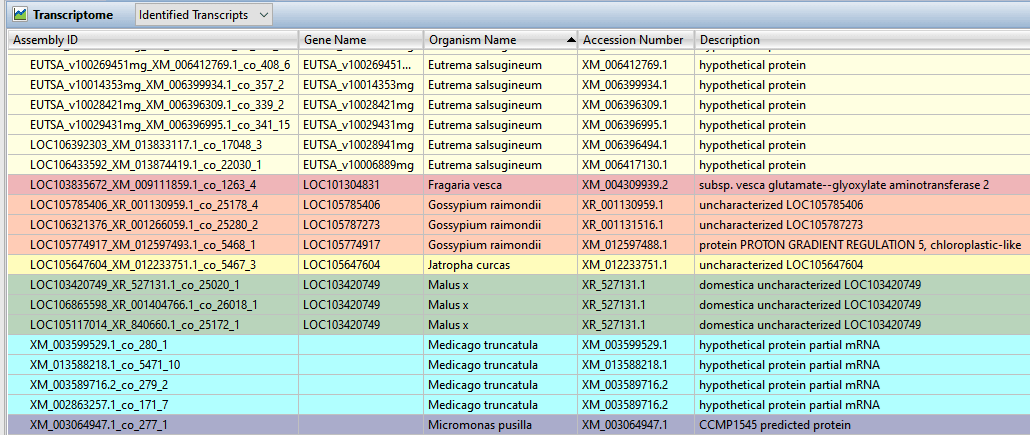
Figure 11. SeqMan Ultra’s “Identified Transcripts” report shown color-coded by Organism Name.

According to the study authors, SeqMan NGen “produced both annotated and novel transcripts lists. The NCBI RefSeq database was used to obtain a number of known or homologous genes from the assembled transcript sequences.” By contrast, “The CLC GW assembly output contained a list of assembled transcripts and unassembled sequence reads.”

To see DNASTAR’s benchmarks comparing identified and novel transcripts assembled for different data sets, see this blog post.

By the way, if you’re curious why the average transcript length found by software is often shorter than the length of the organism’s mRNA, the blog post above also explains this phenomenon. The short answer is that read length makes a huge difference in de novo transcriptome assemblies. Illumina reads over 150bp in length typically produce much longer assembled transcripts–up to full length– while reads less than 150bp may produce transcripts as little as half the length of the mRNA.

Integrated heat maps and gene ontology

You can use ArrayStar to view transcriptome results as a heat map (Figure 12) and to perform gene expression analysis on the transcripts.
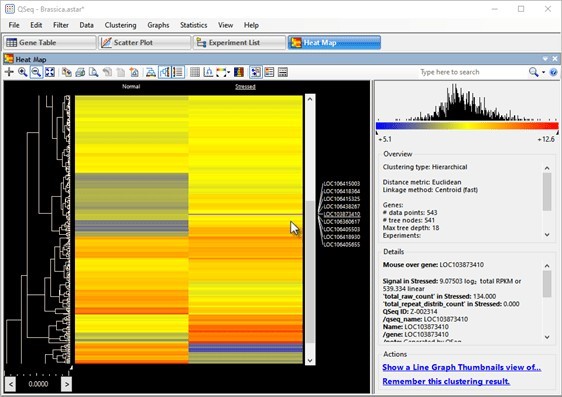
Figure 12. Differential expression of two tissue types in Brassica, as shown in an ArrayStar heat map.

You can also use ArrayStar to explore gene ontology. According to the paper’s authors, “Gene ontology (GO) analysis provides functional description of the genes and existing relationship or functional nodes among genes.” SeqMan NGen “has an integrated tool to perform GO analysis, but not CLC Genomics Workbench.”

PREVIOUS CHAPTER
NEXT CHAPTER

To download this entire ebook as a PDF, click here.

Download This Guide

Would you like to receive technical tips and special offers straight to your inbox?

DNASTAR
Pricing Workflows Training Software Resources Contact Us

Would you like to receive technical tips and special offers straight to your inbox?

2026 - DNASTAR Privacy Policy
This website uses cookies to improve user experience and understand our web usage. By continuing to use our website, you consent to our use of cookies. Accept
Privacy & Cookies Policy

Privacy Overview

This website uses cookies to improve your experience while you navigate through the website. Out of these, the cookies that are categorized as necessary are stored on your browser as they are essential for the working of basic functionalities of the website. We also use third-party cookies that help us analyze and understand how you use this website. These cookies will be stored in your browser only with your consent. You also have the option to opt-out of these cookies. But opting out of some of these cookies may affect your browsing experience.
Necessary
Always Enabled
Necessary cookies are absolutely essential for the website to function properly. This category only includes cookies that ensures basic functionalities and security features of the website. These cookies do not store any personal information.
Non-necessary
Any cookies that may not be particularly necessary for the website to function and is used specifically to collect user personal data via analytics, ads, other embedded contents are termed as non-necessary cookies. It is mandatory to procure user consent prior to running these cookies on your website.
SAVE & ACCEPT